
October 6, 2026
5 mins

I have been researching the problems of stereotyping generations at work for nearly twenty years and how we talk about generations still really frustrates me.
Often, when commentators refer to a specific generational label, what they are really getting at is an aged not generational identity. Aged identities are of course subject to just as much stereotyping as generational identities but are conceptually different. So talk about ‘gen Z’ not understanding, or rejecting, job interview etiquette and bringing a coffee along is really a discussion about the aged identity of being young and may be inexperienced, rebellious or insensitive. Attitudes that are often ascribed to young people and are not particular to an individual generational cohort. Rather aged identities are bound within life course perspectives that suggest that our understandings, attitudes and motivations shift over time as we age.
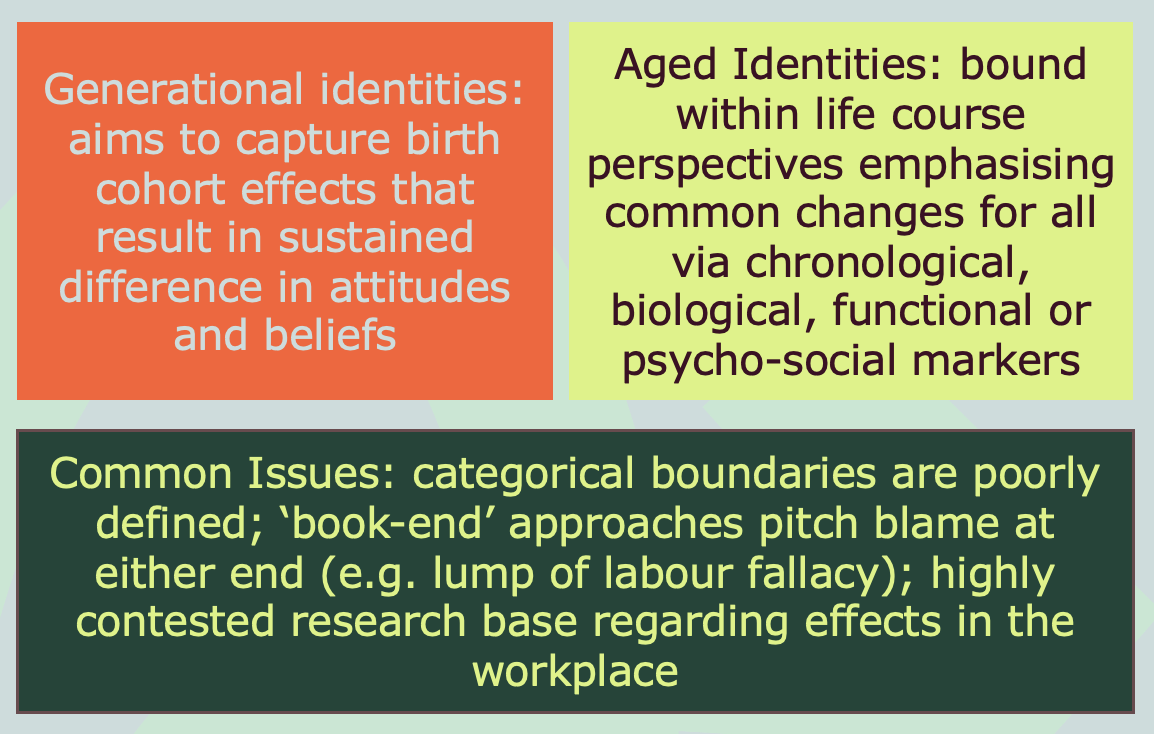
There are many different ways of thinking about age which shape understandings. We are all familiar with chronological perspectives and biological approaches (particularly in relation to health life span vs life span and notions of successful ageing). Functional perspectives combine biological, psychological and/or cognitive markers which psycho-social highlight the importance of self or others’ perception. One approach that is common to both aged and generational perspectives is that of age as a dichotomous, comparative variable which emphasises the importance of distinctions between younger ages/recent cohorts and older ages/former cohorts. This results in what we call the ‘book end’ effect in which both arepositioned as problematic – especially as a result of problematic transitions in and out of work – and as causing issues experience by the other. A common issue that arises here is known as the ‘lump of labour fallacy’ in which it is assumed that there are a fixed and finite number of jobs available and therefore competition between age groups or generations. However research dispelst his myth by highlighting that economic activity is generative, creating morejobs via increased consumption for example. But I digress, let’s get back to generations!
What then are generations? We often use the term to refer to familial generations, the different tiers within family structures over time. But sociologists introduced the idea of generations to capture cohort effects that were often overlooked in understanding how people’s views and attitudes were shaped by social contexts during their formative years. Early discussions focused on the Lost Generation of World War One and the Greatest Generation of World War Two. Here the term was used to capture the fundamental social and economic changes impacting everyday lives, particularly of those who grew up during these times and for who this was their sole reality. The critical difference between aged and cohort identities is that individuals are said to experience cohort effects in a meaningful way throughout their lives; they exert an ongoing impact on attitudes and beliefs for example. Put simply this means that we would expect someone born in 2000 and who is now 26 will feel and believe differently due to cohort effects to someone born in 1980 did at 26. While some researchers offer empirical evidence that suggests these cohort effects are both measurable and significant in their difference from aged effects, this remains highly disputed and very widely rejected by many.
In part this is because the boundaries of generations have rarely been clearly defined or agreed. This was true even of the original silent and greatest generations. This continues to be a significant issue, especially where generations span multiple decades. Moreover unlike the all-encompassing events of world conflict, it has often been difficult to clearly identify cohort defining social factors. Some significant factors, such as the increasing digitalisation of our lives, are ever-evolving rather than clearly bounded while the covid-19pandemic was highly disruptive, it was also relatively short lived. (As a caveat I would say that we don’t yet know the full impact of the pandemic, particularly on young children).
Recent generations have been named by cultural commentators, authors and media and have taken on wider significance as often negative stereotypes. They are largely situated within a western-social cultural context, and in becoming a focus of debates about difference leave other significant factors such as socio-economic status and education level marginalised.
Further debates popular in the media concern intergenerational challenges. While these could be conceived as related to familial generations, commentators often turn to generational cohorts as a short-hand when discussed topics such as inter-generational wealth or workplaces. Indeed a huge business has grown-up around providing advice on how to be generationally savvy in the workplace. Much of this advice is based on very unhelpful and largely inaccurate stereotypes. Many researchers agree that there is as much variation within generations as there is between them, and that generational stereotyping often leads to ageism (of old and young) via the back door. Moreover so much discussion about generational differences blinds us to investigating more carefully what might actually be going on.
So we should all stop the stereotyping, dig into the evidence, and start looking for alternative explanations to help us understand the behaviour of those around us.
Sign up today and we’ll email you with updates, events and more.
Research-led consultancy from two of the UK's leading organisational and qualitative research experts.